Three things people believe about the migration are wrong, and it is worth clearing them away first, because what is actually happening is more interesting than the version on the poster.
It is not a journey. There is no departure and no arrival, no start month and no finish. It is a loop, and the animals in it are simply somewhere on that loop at any given moment.
It is not a herd. It is thousands of small groups, spread over an enormous area, moving at different speeds in roughly the same direction, sometimes doubling back.
And nobody is leading it. There is no lead animal, no decision, no plan. What there is is grass.
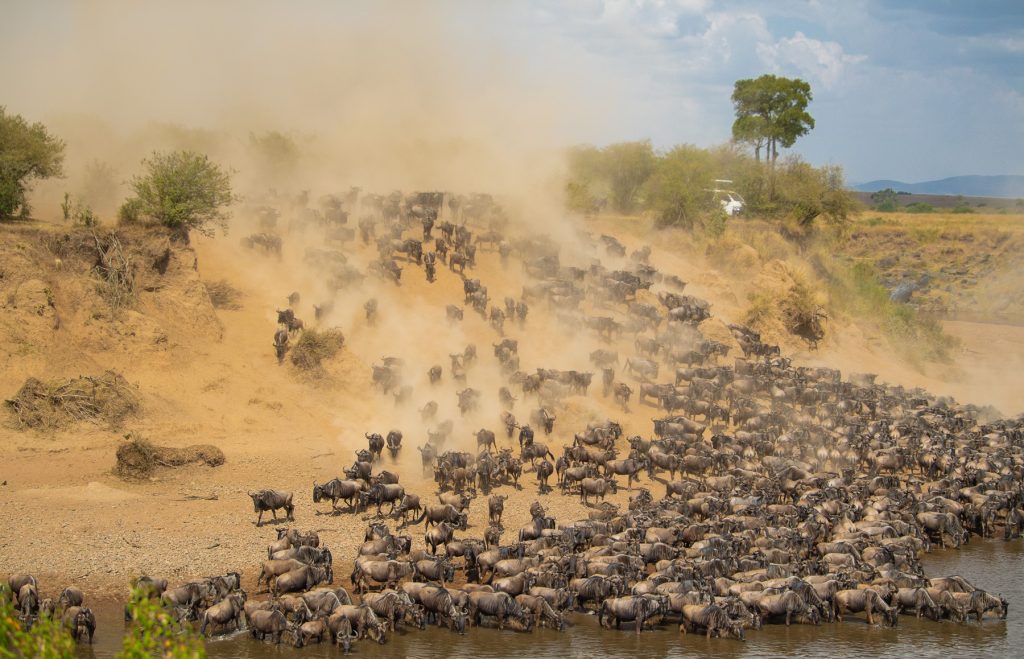
The herds strung out across the open plain
Everything follows the rain
The whole thing is a search for the best grass available, and grass follows rain.
That sounds simple until you look at what “best” means, because it changes across the year and the animals are not choosing between good grass and bad. They are choosing between two kinds of good.
In the far south, on the plains around Ndutu, the soil is shallow, with volcanic ash blown out of the Ngorongoro highlands, sitting on a hard layer that roots cannot easily penetrate. Nothing grows tall there. What does grow is unusually rich in calcium and phosphorus, which are precisely the minerals a pregnant animal needs to build a calf’s skeleton, and a lactating one needs to keep it alive.
So the herds go south for the short rains, and they calve there.
Further north and west the soils are deeper and the grass is taller. There is far more of it. It is also coarser and less nutritious. When the southern plains dry out and burn off in March, the animals trade quality for quantity and move.
That is the entire logic of the migration. Not instinct in any mystical sense, a mineral calculation made over and over by animals responding to what they can smell and see, which includes rain falling a very long way off.
Half a million calves in three weeks
The calving is the part of the year I would recommend to anyone who has already seen a river crossing.
Around half a million calves are born on the southern plains, and the majority of them arrive inside a window of two or three weeks in February. At the peak, something like eight thousand a day.
This synchrony is the whole strategy. Predators on those plains can eat a certain number of calves per day and no more; they are full, and the calves keep coming. Spread the same births across three months, and almost all of them would be taken. Compress them into three weeks and most survive by sheer statistical swamping.
A wildebeest calf stands within minutes of being born and can run with the herd the same day. It has to. There is nowhere to hide on a short-grass plain, which is exactly why the mothers chose it; you can see a lion coming from a kilometre away.
The crossings
By July the front of the movement is reaching the Mara River, and this is the part everyone comes for.
It is worth being honest about what a crossing is.
It is not brave. The animals do not weigh the risk and decide to accept it. Pressure builds at the bank as more animals arrive behind, someone at the front is pushed in, and then the rest follow because wildebeest follow. They may cross, mill about on the far bank, and cross back an hour later for no reason anyone has satisfactorily explained.
Researchers working on the Mara River have estimated that an average of around six thousand wildebeest drown in it each year. That is not a failure of the system. It is part of it, a thousand tonnes of carcass entering the river annually, feeding crocodiles first, then fish, then the algae and biofilm on the rocks for years afterwards. The river is measurably richer because of the drownings.
Nothing about this is designed. It is simply what happens when a million animals meet a river twice a year.

A crossing, from the bank
The thing most people do not know
The infographics tend to say this cycle has run unchanged for centuries. It has not.
In the 1880s a cattle disease called rinderpest arrived in Africa and moved through the continent catastrophically. It killed wildebeest and buffalo along with the cattle. For most of the following seventy years, the Serengeti wildebeest population sat at a fraction of what it is now, a few hundred thousand animals at most, and the migration was correspondingly smaller.
Rinderpest was eliminated from the ecosystem in the early 1960s through vaccination campaigns in the surrounding cattle. The wildebeest population then did something extraordinary: it grew from roughly a quarter of a million to over a million within about fifteen years and has held there since.
Which means the migration, as we know it, the scale of it, the crossings, and the sheer weight of animals is around sixty years old. It is not ancient. It is a recovery, and it happened within living memory.
I find that more remarkable than the version where nothing has ever changed.
Two things your guide knows and the internet does not
Not every wildebeest in the Mara came from the Serengeti. There is a second, separate population, over a hundred thousand animals, that lives on the Loita Plains to the east and moves into the reserve on its own schedule. In some years they are here well before the Serengeti herds arrive. Guests are frequently shown wildebeest in June and told they have seen the migration. They have seen a migration. It is not the one they read about.
The predators do not follow. Lions are territorial and stay where they are. What happens in July is not that the predators move to the food; it is that the food arrives at the predators, in unimaginable quantity, for three months. Then it leaves, and they go back to hunting topi and warthog. This is why the resident game here is strong all year and why a Mara safari in March is a genuinely good safari rather than a consolation.
When to come, honestly
The crossings are most likely between July and October. That is as precise as anyone can responsibly be.
The herds respond to rain, and rain does not consult the calendar. In some years the animals arrive in late June. In others the river is quiet through most of August. You can be in the right place, in the right month, with the best guide in the reserve, and watch nothing cross for four days.
Anyone who guarantees you a crossing is either misinformed or hoping you will not remember the conversation.
What can be said is this. Ilora sits in the central Olkiombo, about ten minutes from the main crossing point, which means that when something begins, we are close enough to be there for it rather than arriving as it ends. And it means the rest of the year, when the herds are eight hundred kilometres south and the plains here are quiet, you are still in the densest big-cat country in Africa, which was always the better reason to come.
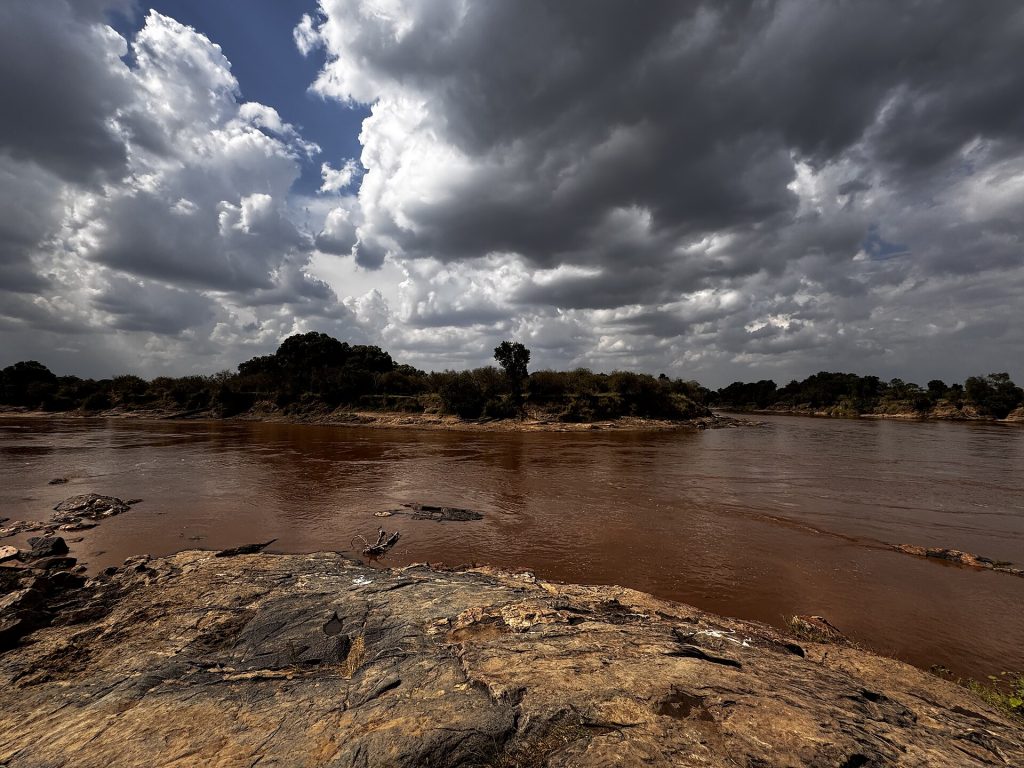
The river, empty, early morning
A share of every stay at Ilora supports the Mara Predator Conservation Programme and the Mara-Meru Cheetah Project.