Nobody found her.
That is usually how it ends with a leopard. There is no body, no morning where somebody radios it in. There is simply a week when she is not in the fig, and then another, and then a month, and at some point you stop driving that loop hoping.
Bahati was last seen in March 2024. She was thirteen and a half years old, which for a wild leopard is a long and improbable life, and she had held this ground for most of it.
Our first guests arrived four months later.
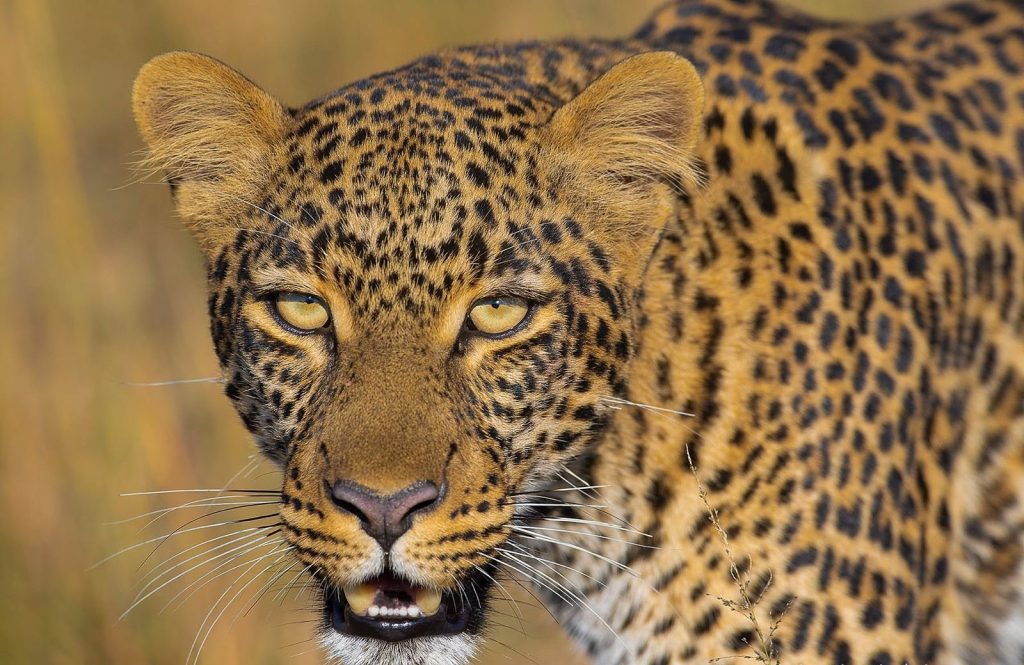
Bahati staring straight into the camera with her strong gaze
The lucky one
Her name is Swahili for the lucky one, and she was given it as a cub in the Talek country, which is a short distance from here and no distance at all to a leopard.
She came from the most closely watched leopard family in Africa. Her grandmother was Bella. Her mother was Olive, named for the wild olive she liked to lie in, and Olive spent a decade in front of BBC cameras until lions killed her in September 2013. People who have never been to Kenya can tell you about Olive. There is a camp in this reserve named after her.
Bahati was one of a litter of two. The other did not last, which is not unusual and is worth saying plainly rather than passing over. Most leopard cubs do not reach adulthood — lions kill them, hyenas kill them, other leopards kill them. A female who raises two cubs to independence has done something remarkable, and Olive managed it repeatedly.
Bahati outlived her mother by more than a year.
Why she was here
There is a mechanism behind this that is easy to miss, and it is the reason this piece exists at all.
A young male leopard, on reaching independence, is pushed out. He travels a long way, fights for ground that belongs to someone else, and frequently dies attempting it. A young female does something quieter. She stays close. She takes a piece of her mother’s range, sometimes overlapping it, sometimes carved from the edge, and she holds it for the rest of her life.
Which means a female leopard’s territory is not somewhere she found. It is somewhere she was given, by an animal who was given it in turn.
The riverine forest along the Talek, the thickets, and the figs with the low horizontal branches a leopard can walk along and a lion cannot — that ground was held by this family across three generations we know of, and certainly more that we do not.
We bought here in 2019 and opened in July 2024.
So she did not make Ilora her home. Ilora is thirty acres of her home, and for the last years of her life she spent something close to half her time inside it. Not passing through. Living in it. Thirty acres of thicket with no vehicles after dark and fewer lions willing to come in is, from a leopard’s point of view, an improvement on what surrounds it.
Our guides knew her better than anyone else in this reserve knew her, for the straightforward reason that half her life happened within a few hundred metres of where you are sitting.
On foot
The photographs I value most of her were not taken from a vehicle.
You would be walking the property on some ordinary errand — checking a water line, moving between the kitchen and the store — and there she would be, asleep in a thicket eight or ten metres off the path, having chosen that spot some hours earlier without consulting anybody.
There is a particular adjustment the mind makes at that moment. It is not fear, quite. It is the recognition that you have been walking through her house all morning under the impression that it was yours.
She would open one eye. Establish that you were the usual nuisance rather than a new one. Close it again.
Over the years I photographed her a great deal — from vehicles, on foot, in trees, on kills — and across more than one litter. Cubs in the thickets, cubs learning to climb badly, cubs following her out at dusk and being brought back. Sequences that ran across months. Some of those cubs made it. Most did not, because most do not.
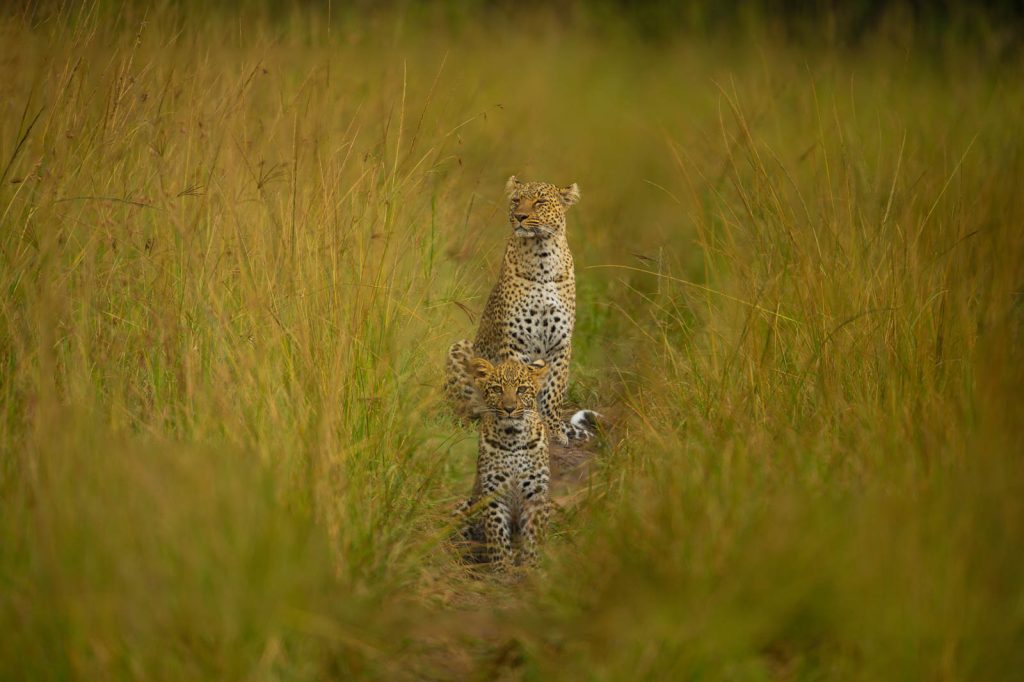
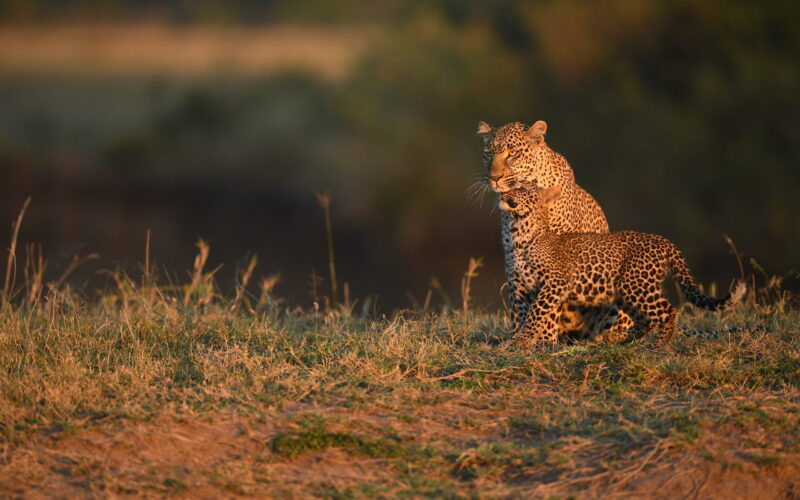
Bahati with her cub
What she was good at
Everything a leopard does is a solution to the same problem. She is not the strongest animal in this landscape, and everything stronger than her wants her food.
So she worked at night where she could. She hunted alone, from cover, at ranges that would be useless to a cheetah. And having killed something she did the thing that defines her species — took it up a tree, hauling an animal that might weigh as much as she did, vertically, on her teeth and shoulders, because a carcass fifteen feet in the air is a carcass no hyena will ever eat.
I watched her do that and I still do not entirely understand how.
There was also something in the way she moved through this place that I never got used to. Not stealth exactly — stealth implies effort. She simply belonged to the ground in a way that we, with our decking and our lamps and our carefully considered pathways, plainly did not. She would cross a road, a riverbed and a construction site in four minutes without registering that any of the three existed.
Our maps were not her maps. She had her own, and it was older.

Bahati crossing open ground
Four months
The part I keep returning to is the timing.
She was here through all of it. Through the years the site sat as something else, through the rebuild, through the noise and the vehicles and the slow arrival of a camp on ground that had been hers and her mother’s and her grandmother’s. And she stayed — not tolerating it from a distance, but sleeping in the middle of it.
Then in March 2024 she stopped appearing, and in July the first guests walked in.
Almost nobody who stays at Ilora will ever have seen her. She is not a sighting we can offer. She belongs entirely to the period before there was anything here to offer it from — to the guides who knew her, the builders who watched her pass at dusk, and to a great many photographs.
There is no ending to give you. We do not know what happened. She was thirteen and a half; something in that landscape catches up with every leopard eventually, and it does not usually leave an explanation.
The bar is named after her
Not as a marketing decision. It is simply what everybody was already calling that part of the camp, because that was her ground and everyone who worked here knew it.
Bahati Bar sits where she used to sit. Guests order a drink there without knowing, and that seems about right — she was never ours to introduce.
The ground remembers
Here is what has not changed.
There is a leopard in those thickets now. There will be one next year. Female leopards inherit, and the inheritance in this stretch of riverine forest runs back at least to Bella and probably a great deal further. She raised cubs here across more than one litter, and daughters do not go far.
So when a guest sees a leopard at Ilora — and they do, and it remains the thing they talk about on the way to the airstrip — the odds are good that they are looking at Bahati’s line without knowing her name.
That seems to me the right way for it to work. The individual was temporary. She would have been the first to demonstrate it, walking through a camp she had every right to ignore, on ground that was hers long before it was ours and is hers still in every way that matters to a leopard.
We were fortunate to overlap with her at all.
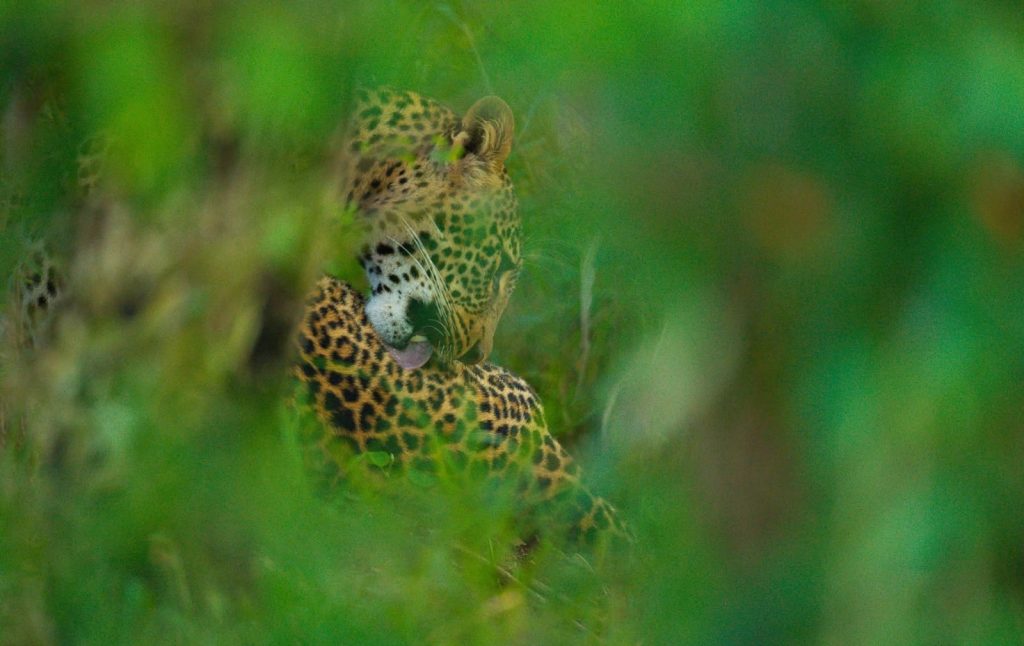
Spotted inside the Ilora Retreats
A share of every stay at Ilora supports the Mara Predator Conservation Programme, which identifies and follows individual leopards and lions across this ecosystem — the ones whose names we know, and the many more we do not.