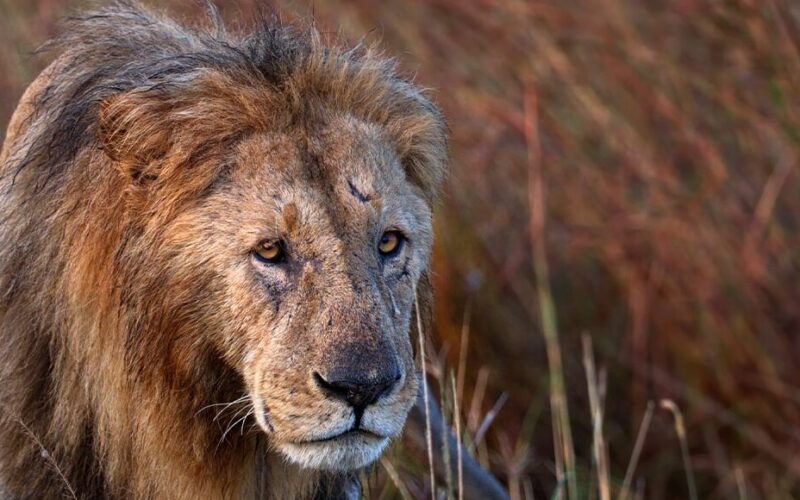
Everyone arrives with a list of five animals. Lion, leopard, elephant, buffalo, rhino — the Big Five, a hunting inventory that became a checklist.
Somebody in the safari industry then coined the Ugly Five as a joke: warthog, vulture, marabou stork, spotted hyena, wildebeest. The joke has outlived its usefulness. Remove any one of these from the Mara and the ecosystem stops working. Remove the leopard and it does not.
Warthog
Grey, sparsely bristled, with facial warts that are protective padding for fighting, and four tusks — the upper pair curving outward, the lower pair short and genuinely sharp.

They graze kneeling on the front knees, which develop calluses for it, and that posture lets them crop grass shorter than any other grazer here. They can run at close to fifty kilometres an hour with the tail held vertically, which is the sight everyone photographs.
The ecological work happens underground. Warthogs occupy and enlarge burrows dug by aardvark, and when they leave, hyena, jackal, mongoose, warthog again, porcupine and a long list of others move in. They reverse into a burrow rather than turning around, so they come out facing whatever is waiting.
Vultures
Six species work the Mara: Rüppell’s, white-backed, lappet-faced, hooded, white-headed and Egyptian. They arrive at a carcass within minutes, and between them they can strip a wildebeest in about half an hour.

Their stomach acid runs near pH 1 — strong enough to destroy anthrax, botulism toxin, rabies and cholera. That is the entire service: pathogens that would otherwise sit in a rotting carcass and move into water, scavengers and livestock instead end in a vulture and go no further.
East African vulture populations have fallen by more than eighty percent in thirty years. The main cause is poisoning — carcasses laced to kill predators, which then kill hundreds of birds at a time — and the collapse is well documented in India, where the loss of vultures produced a measurable rise in feral dog numbers and in human rabies deaths.
Watching vultures on a kill is not the unpleasant part of a game drive. It is the part with the most at stake.
Marabou stork
Bald head, bare pink neck, a hanging throat sac, and a wingspan of up to three and a quarter metres — among the largest of any land bird alive.

The bare head is functional, exactly as it is on a vulture: feathers on a head that goes inside a carcass would carry bacteria. Marabou feed alongside vultures and take what the beaks cannot, plus fish, frogs, insects, small mammals and, near towns, refuse.
They nest colonially in tall trees and on cliffs, returning to the same nest year after year and adding to it. In several East African cultures they are associated with death and the passage after it, which given the company they keep is not surprising.
Spotted hyena
The most misrepresented animal in Africa. Hyenas are not primarily scavengers — they kill the majority of what they eat, hunting cooperatively and successfully, and lions steal from them at least as often as the reverse.

Clans run to eighty animals and are matriarchal. Females are larger, heavier and dominant over every male in the clan, and the lowest-ranking female outranks the highest-ranking male. Social intelligence is high: in problem-solving trials they perform comparably to primates, and they recognise individual clan members by call.
The jaw generates enough force to break and consume bone, which no other large carnivore here does. What that means in practice is that the last of a carcass — the skeleton — is recycled rather than left, and the calcium goes back into the soil in their droppings, which is why hyena scat turns white.
The famous laugh is not amusement. It is a signal of stress, usually from a low-ranking animal under pressure at a kill.
Wildebeest
Sloping back, box head, and a permanently anxious expression. Roughly 1.5 million of them, and the entire Mara–Serengeti system is arranged around their movement.
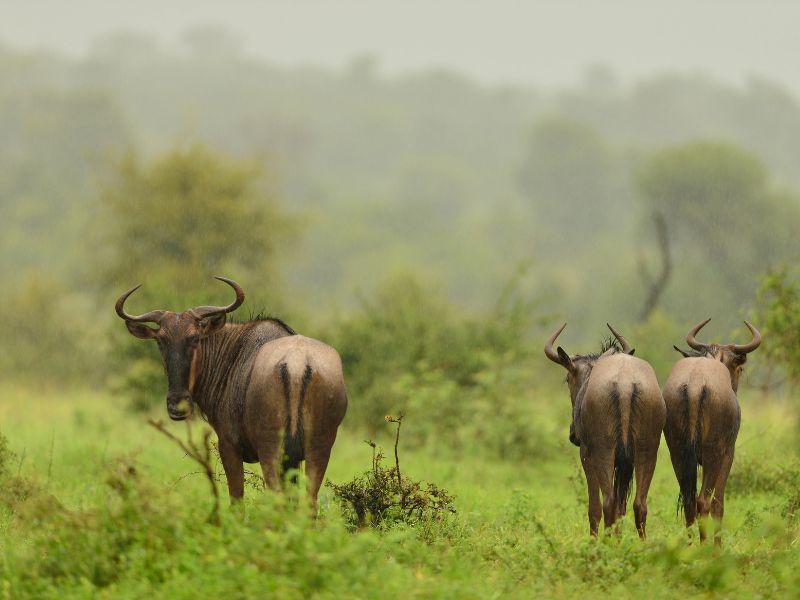
They arrive from the Serengeti around July and stay into October, and while they are here they mow the grassland down. That grazing is not damage — it triggers regrowth, stops the plain turning to rank unpalatable stem, and their dung and urine move nitrogen and phosphorus across hundreds of kilometres in a way nothing else can.
They are also the food supply. Every lion, hyena, cheetah, leopard, crocodile and vulture in this ecosystem is fed, directly or indirectly, on the back of this one migration. Take out the wildebeest and the predator populations that people fly here to see do not survive at their current size.
Names are not descriptions
The Big Five were chosen by men who wanted to shoot something dangerous. The Ugly Five were chosen for a laugh. Neither list has anything to do with how the Mara actually functions.
Ask your guide to stop at the next kill and stay with it rather than moving on. Watch what arrives, in what order, and how quickly the ground is clean. That is the reserve doing the thing it does — and none of the animals doing it are on the first list.