The Maasai are semi-nomadic pastoralists across southern Kenya and northern Tanzania, and the most recognised people in East Africa — red shuka, beadwork, and a life still organised around cattle.
Within that society, warriorhood is the stage everything else is measured against. A moran is not a soldier and not a job. It is a period of life, entered together with the other boys of your age and left together, and it shapes the rest of your standing in the community.
The age set: the institution underneath everything
Before the ceremonies make sense, the structure does. Maasai society is organised into age sets — cohorts of men initiated within the same window of years, who then move through life together as a single body.
A new age set is opened at intervals of roughly a decade and a half, given a name, and closed. Every man initiated in that window belongs to it permanently. He will call the others his age-mates for sixty years, share obligations with them, avoid certain things in front of them, and be entitled to hospitality from any of them anywhere in Maasai country.
This is the load-bearing wall of the whole society. It cuts across clan and family, so a man’s strongest horizontal loyalties are to people he is not related to. It produces a chain of authority — junior warriors, senior warriors, junior elders, senior elders — where seniority is a function of when you were born rather than what you own. And it means decisions are taken collectively by a group that has known each other since they were fourteen.
Becoming a moran
Boys are grouped into an age set in their early teens and go through the whole process together — an association that lasts the rest of their lives.

The transition is marked by emorata, circumcision, performed without anaesthetic by elders. Composure is the test: a boy who flinches or cries out is judged unready, and the judgement follows him. It is the most serious moment in a Maasai man’s life, and it is not performed for visitors.
The point is not endurance for its own sake. A society whose wealth walks around on four legs and can be driven off in a night needs to know, in advance and in public, which of its young men will hold under pressure. The ceremony is an assessment, conducted once, with the whole community watching, and the result is remembered.
After healing, the group’s heads are shaved and they move out of the village into a manyatta of their own — a settlement built for the warriors and their mothers, deliberately separate from the family homesteads.
What follows is months and then years of training under elders and older morans: covering long distances on foot, handling and slaughtering livestock, weapons, navigation, and above all keeping predators off cattle. Historically, killing a lion single-handed carried enormous status. That practice has been given up — it is illegal, and the community has largely turned it around into protecting lions rather than killing them.
Morans do not marry. They serve roughly ten to fifteen years, and the period closes at the eunoto ceremony, where the head is shaved again — traditionally by the mother — and the man takes on marriage, a household and, in time, a place among the elders.
Eunoto is a bigger event than the initiation that started it. It runs for days, draws age-mates from a wide area, and involves the whole cohort graduating at once. A man does not become an elder on his own timetable; he becomes one when his age set does.
How a moran looks, and why
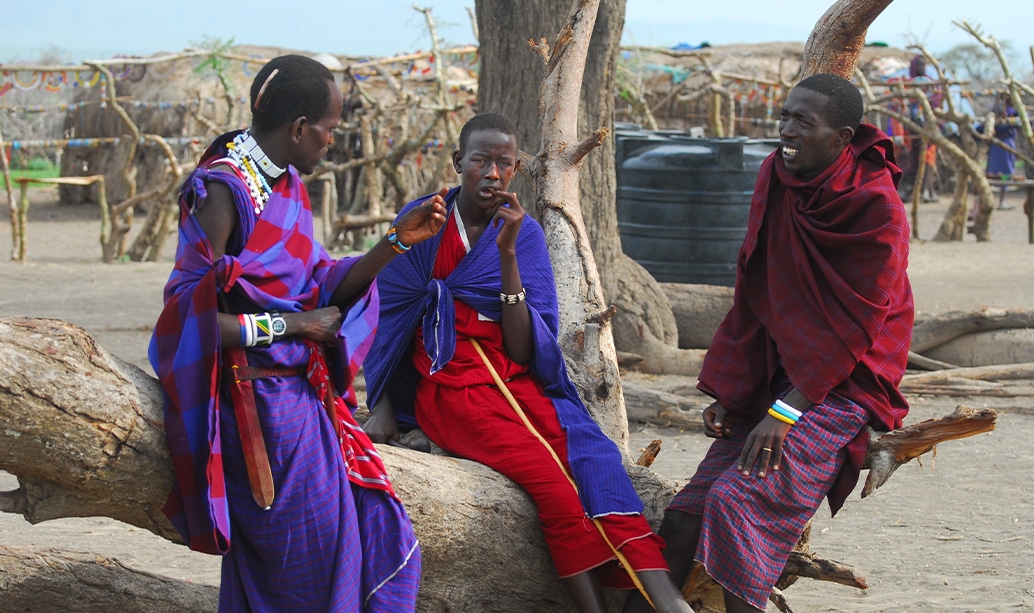
The red ochre is not decoration. Ground ochre mixed with animal fat is applied to skin and hair, and it works as sun protection and as an insect repellent. The hair is grown long and braided — the one period in a Maasai man’s life when hair is worn long — and the whole effect is meant to be visible at distance, to other morans and to predators.

Beadwork carries information: red, black, blue and white in particular combinations signal age set, status and occasion, readable across a field by anyone raised with it. Red is blood and courage, white is milk and peace, blue is sky and rain, green is the grass that follows it. Earrings, armbands and anklets go with it, and most of it is made by the women of a moran’s family — which means what a man wears is partly a statement about who is behind him.
Most carry a spear and a short sword, the ol alem, worn at the waist. Most also carry a small mirror, and use it, which surprises visitors more than it should. Appearance is not vanity here; it is a formal signal, and a badly turned-out warrior reflects on his age set.
The day
Morans live apart from their families, out in the bush rather than in the village. They move in groups through the day, chanting as they walk — partly for the pleasure of it, partly because a group heard coming is a group that does not surprise a buffalo.
That last point is the whole philosophy of moving through this country on foot. Almost every serious injury in the bush comes from a close-range surprise: a buffalo in thick cover, a hippo between you and water, an elephant with a calf. Noise, made deliberately and at the right volume, is a safety system.
When they meet an elephant or a lion they hold their distance and move it off. They do not hunt it. The point has never been killing wildlife; it is keeping it away from cattle.
Food comes from the herd, not the bush: milk, and blood drawn from a living animal’s neck and mixed with milk, which is the traditional warrior’s diet. The animal is not killed — a blocked arrow is used to open a vein, and the wound is sealed afterwards. Meat is eaten together when an animal is slaughtered, and there are rules about who may eat what in whose presence.
Wild game is not food, and never was. That single cultural fact is the plainest reason the Mara still holds the game density it does.
Cattle raiding between communities still happens, and it is high-risk. Being caught costs prestige and heavy fines in cattle, and among a people who count wealth in livestock, that is a serious penalty.
Disputes inside the group are settled by the eldest warrior. He taps each man on the shoulder in turn, the others shake hands, and he watches to see that everyone takes part. It looks slight and it is not — the whole authority of the age set rests on the group holding together, and a quarrel that survives the evening is a crack in something the community depends on.
The rest of the time
They wrestle. They dance the adumu, the jumping dance, competitively and constantly — height is the whole contest, the body stays straight, and the heels are not supposed to touch the ground between jumps.
And they play a game that tells you a great deal about how well they know this country: someone startles a giraffe, everyone predicts how far it will run before stopping, and the closest guess wins. The distance is then paced out.
Read that again. It is a game about predicting animal behaviour, scored by measurement, played for entertainment, over and over, for years. It is also, precisely, the skill a tracker needs. The training is disguised as play, and it produces people who can tell you where an animal is going before it goes there.
What changed, and what did not
Many morans now work with conservation. In the Mara they find and clear poachers’ snares and pass information to rangers, and a large number of the rangers and guides working in the reserve and the conservancies — including at Ilora — came out of exactly this training.
That is a real shift: the same skills that once tracked a lion in order to kill it now track one in order to count it. It has also changed the economics of a young man’s life. Warriorhood used to have no cash value. It now leads directly into paid work as a guide, tracker, ranger or camp manager, and that income supports a household that would otherwise depend entirely on cattle in a climate that is becoming less reliable.
Schooling has changed the shape of it too. Many boys now go through secondary education alongside the age-set process rather than instead of it, and a moran who has done both is the person most camps want to employ.

The rest holds. The age sets, the ceremonies, the cattle, the standing that comes from how you conducted yourself at fourteen. It is one of the very few societies in East Africa that has modernised at its own pace rather than someone else’s.
If you meet one
You will, if you come here — the guide who takes you out, the tracker on the front seat, the man who walks you back to your tent after dinner.
Ask him about his age set and its name. Ask what year it was opened, and who else belongs to it. Ask how a dispute is settled and what happens to someone who ignores the ruling. Those questions produce a conversation. Questions about lion hunts produce a polite answer to something that stopped being true a generation ago.