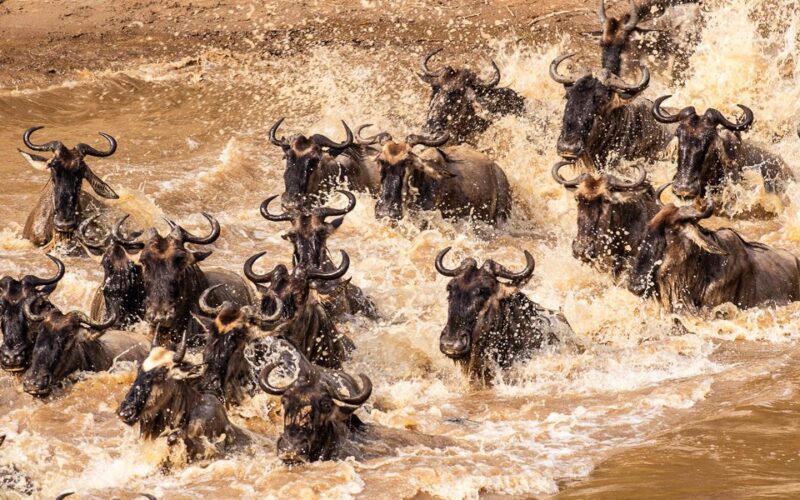
Everyone comes for one migration. Between July and October, something over a million wildebeest push north out of the Serengeti, mass on the banks of the Mara River, and eventually go. It is the most photographed animal movement on earth and it deserves the attention.
It is also not the only one, and for most of the year it is not even the one happening outside your tent.
The Mara runs on smaller, shorter, more regular movements — some of them a hundred kilometres, some of them three, some of them nightly. They are the reason the plains hold game in February as well as in August. Once you know which animal is going where and why, an ordinary morning drive in the green season stops looking like a consolation prize.
The Loita wildebeest: Kenya’s own migration
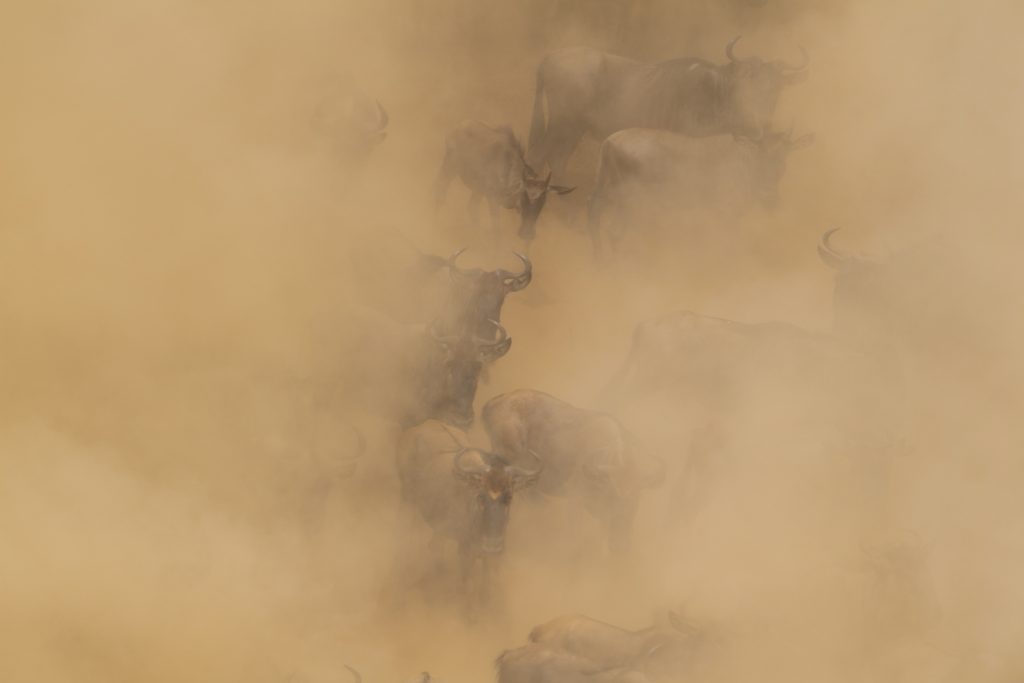
There is a second wildebeest population that never sees the Serengeti. They breed and calve on the Loita Plains, open grassland to the north-east of the reserve, and they spend the wet months up there where the grass is fresh and the predators are thinner on the ground.
As the Loita Plains dry out — usually from May, sometimes June — they move south-west into the reserve, arriving weeks before the Serengeti herds. By the time the river crossings start, the Loita animals have already been in the Mara for a month or more. When the short rains break in November they turn around and walk back.
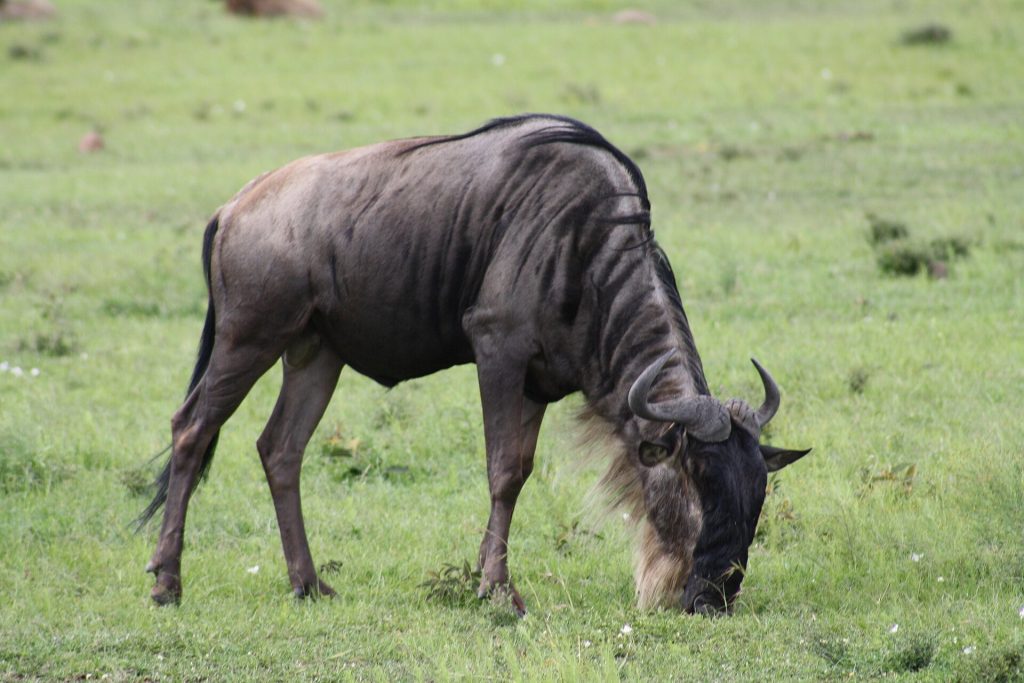
This is the movement most worth knowing about, and the one under most pressure. Counts in the late 1970s put the Loita population well above a hundred thousand animals. Recent estimates are a fraction of that. The cause is not poaching or drought but land use: wheat farming and fencing across the Loita Plains have cut the calving ground and closed the route between it and the reserve.
A migration does not need to be hunted to disappear. It only needs its two ends to stop being joined.
Elephants: to the forest and back
Mara elephants are not resident in the sense that a hippo is resident. They move on a wet-and-dry cycle between the open reserve and the forested high ground around it.
When the rains come and water is everywhere, family groups disperse out of the reserve — east and north-east into the Loita Hills, and west across the Mara River into the Nyakweri Forest in Trans Mara. Both are browse-rich and both offer cover, which matters most when there are small calves in the group. The Loita forest, Naimina Enkiyio, is sacred ground to the Maasai who hold it, and that status has protected it more effectively than any fence.
When the pans dry, they come back down to permanent water — the Mara and the Talek. This is why elephant sightings around Olkiombo become almost routine in the late dry season and thin out after heavy rain. The animals have not vanished. They have gone uphill.
Grazing succession: three species, one field, in order
The most elegant movement in the Mara happens across a few hundred metres, and it happens in a fixed sequence.
Zebra go first. They are hindgut fermenters, able to process coarse, stemmy material that would not repay a ruminant, so they take the tall old growth and open the sward.
Wildebeest follow into what the zebra have opened, cropping the leafy middle layer that is now within reach and exposed to light.
Thomson’s gazelle come last, onto the short green regrowth and the small broad-leaved plants that only appear once the grass canopy is off them.
Each species leaves the field better for the next. Watch a patch of the eastern plains over a fortnight and you can see the sequence run through it. This is the machinery underneath the spectacle, and it is visible from a stationary vehicle with the engine off.
The nightly migration nobody watches
Hippo spend the day in the river because their skin will not take the sun. At dusk they leave it, in single file, and walk out to graze — commonly two or three kilometres, sometimes considerably further — returning before first light.
They use the same routes night after night, and those routes become deep, smooth, unmistakable paths cut down the riverbank. They crop the grass around them to a tight lawn that other grazers then use. A hippo is a nocturnal lawnmower with a fixed commute, and the evidence of it is all over the ground between the Talek and the Mara.
You will not see this from a vehicle inside the reserve after dark. You will see the paths, and now you will know what made them.
Eland, topi and the shape of the ground
Eland are the largest antelope in Africa and the most mobile. They range far wider than their size suggests, moving between the reserve and the hill country according to grazing and disturbance, and they are shy enough that seeing a herd properly is a matter of luck rather than skill.
Topi mostly stay, but they shift with the grass and concentrate on the eastern plains where males hold small display territories and stand on termite mounds. The mound-standing is not sentry duty, whatever your guide’s joke suggests; it is advertising.
Cheetah track the short grass, because they need to see and they need room to run. When the grass comes up in April the cheetah move to where it has not. Follow the sward height and you have narrowed your search from 1,500 square kilometres to a few.
The birds are the biggest migration of all
By numbers, nothing on the ground competes with what arrives overhead.
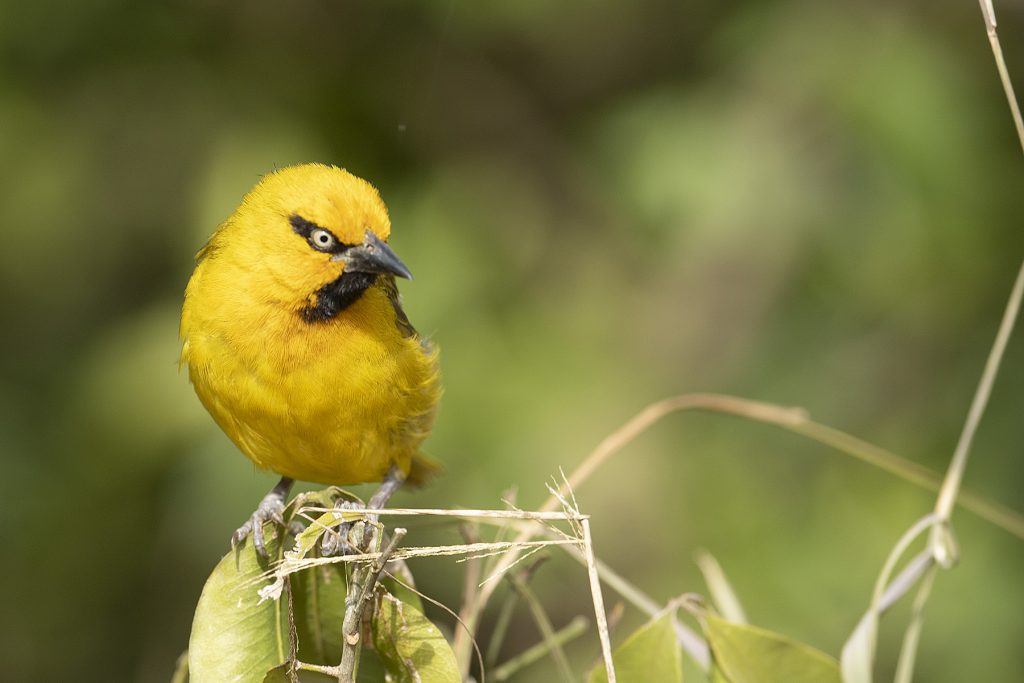
From around November, Palearctic migrants come down from Europe and Asia and stay until March: white storks, European rollers, Eurasian bee-eaters, steppe eagles, lesser kestrels, Montagu’s and pallid harriers quartering the grass, red-backed shrikes on every second bush. They roughly double what you can put on a morning list.
Then there is the intra-African movement, which is less famous and more precisely tied to weather. Abdim’s stork arrives with the rains and is known across the continent as the rain bird for it. Woodland kingfishers turn up when the storms do and announce themselves loudly enough that you will ask what they are.
The trigger for most of it is the same event: the first proper rain, which brings termite alates off the mounds in their millions for a single evening. Storks, rollers, bee-eaters, kites and hornbills all converge on that hatch. It lasts an hour or two and it is one of the best things in the Mara calendar.
Why any of this needs open ground
Every movement above depends on the same thing: a continuous, unfenced route between two places an animal needs at different times of year. Conservationists call these wildlife corridors. In practice they are ordinary ground that nobody has built on, ploughed or fenced.
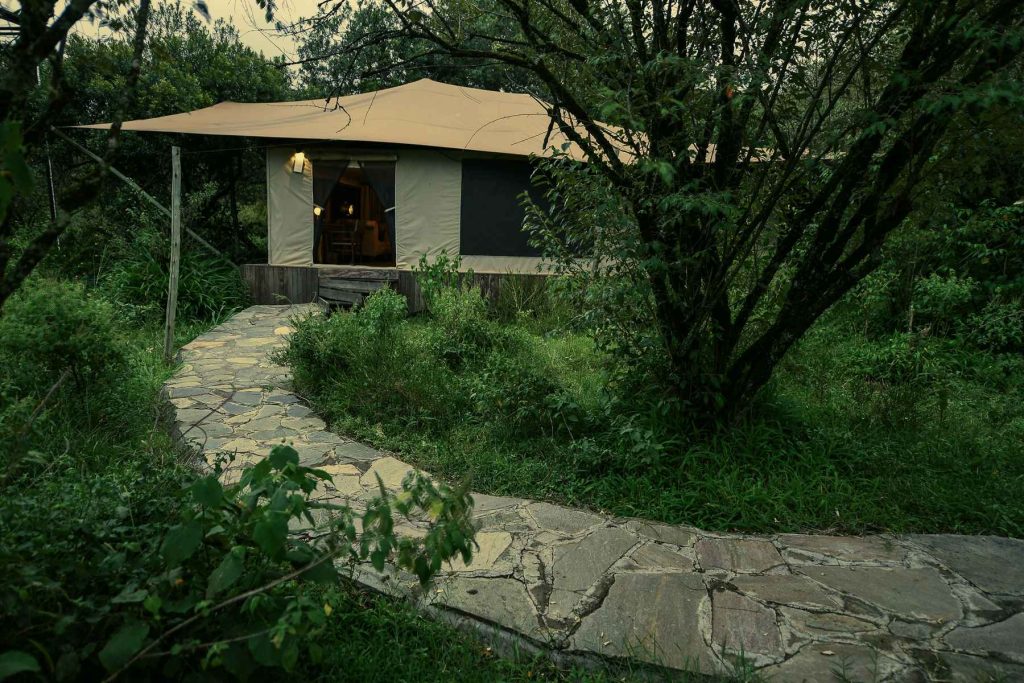
Ilora sits on thirty acres in central Olkiombo, and under five percent of that ground carries any structure. The rest is left as riverine forest and grass, uncleared and unpaved. Fourteen suites are set in a circle within it, so that game moving between the Talek and the Mara passes through rather than around.
That is not a design flourish. It is the difference between a camp an animal detours around and a camp it walks through without changing pace.
What this means for when you come
The river crossings run July to October and nothing replaces them. But if those months do not suit you, or the crowds do not, the alternative is not an empty Mara.
November and December bring the storm light, the migrant birds and the termite hatches. January to March gives you cats with young cubs, resident antelope calving, and the best birding of the year. April and May are wet, green, difficult underfoot and almost private. May and June bring the Loita herds down before anyone else arrives.
Something is always moving here. The great migration is simply the one loud enough to hear from a distance.
Unrushed. By nature.