Lion, leopard and cheetah take the attention, and fairly. But three smaller cats live on the same ground, and finding one is harder — and for a lot of guests, more satisfying — than any big cat sighting.
They are nocturnal or close to it, they are small, and they do not want to be seen. Ask your guide before an early drive or a night drive in the conservancies, and be patient.
African wildcat
The ancestor of every domestic cat on earth. Egyptians tamed this animal around ten thousand years ago, and the resemblance is unnerving: from twenty metres it looks exactly like a tabby that has been left out in the sun.
The differences are in the legs, which are longer, and the sitting posture, which is upright and formal in a way domestic cats are not — the posture in every Egyptian tomb painting. The coat runs from sandy red to grey-brown with faint striping, black bands on the legs, and a reddish-brown wash behind the ears that is the reliable identifier.

African wildcat
They hunt rodents, birds, reptiles and insects, mostly at night, and they will take carrion. The species ranges far beyond Africa, across the Middle East and into Central Asia.
The threat to them is not poaching or habitat. It is interbreeding with village cats. Genetically pure African wildcats are becoming difficult to find anywhere near human settlement, which makes the ones out here worth more than they look.
Serval
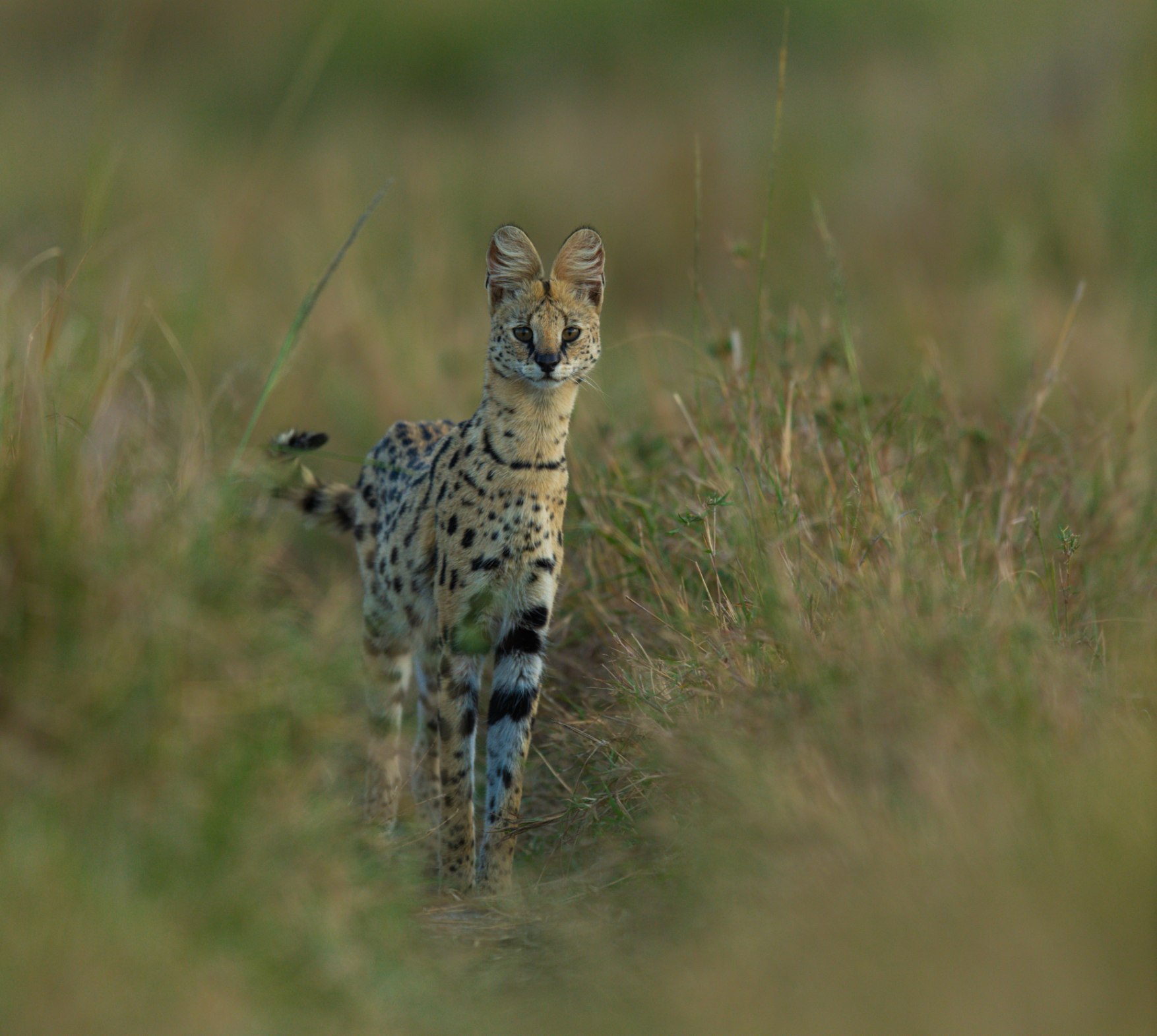
The most likely of the three to be seen, and the most striking. A serval is built like nothing else on the plain: very long legs, a small head, and ears so large they look borrowed.
Serval
Those ears are the point. A serval hunts by sound, standing motionless in long grass until it locates a rodent it cannot see, then jumping — straight up, two or three metres — and coming down on it with both front feet. The success rate is around fifty percent, which is roughly double what a lion manages.
They weigh nine to eighteen kilograms and stand about sixty centimetres at the shoulder. The black-spotted coat gets them mistaken for small cheetah at a distance; the long neck has earned them the nickname giraffe cat.
Look for them in the wet grassland near watercourses, at first light or on a night drive. They are the small cat you have the best chance with.
Caracal
The largest of the three, and the one with the ears everybody photographs. The name comes from the Turkish karakulak, black ear; in Afrikaans it is rooikat, red cat.

Caracal
The long black tufts on the ear tips are controlled by around twenty separate muscles, and the current thinking is that they are used for signalling between cats as much as for hearing. The coat is a plain reddish-brown with no spots at all, which distinguishes it instantly from the other two.
A caracal weighs up to eighteen kilograms, is extremely fast over short distance, and can leap around three metres from standing — high enough to take birds out of the air, which it does. It hunts small antelope, hares, rodents, monkeys and birds, and it is the most elusive of the three. Most sightings here are a shape crossing a track at dusk.
Worth saying
The genets and civets you may see at night are not cats. They are viverrids, a separate family, and closer to the mongoose. Nobody minds if you call a genet a cat, but your guide will enjoy correcting you.
The small cats keep rodent numbers down, and rodent numbers determine a great deal about how the grassland works. They matter more than their size suggests, which is generally true of the things that are hardest to see.