The alarm goes at half past four. You are at the launch site in the dark, watching burners fill a balloon the size of a building, and airborne as the sky turns. For the next hour you drift a few hundred feet over the plains with the burner off, and the only sound is the wind and whatever is below you.
It is the one thing in the Mara that changes what you understand rather than what you have seen.

What it shows you that a vehicle cannot
From a vehicle you see animals. From a balloon you see the system: the Mara river cutting across the plain, the Oloololo escarpment holding the western edge, the pattern of thicket and open grass, and where the herds actually are — often several kilometres from where you assumed.
Low passes bring you over hippo pods, elephant families moving in file, and lion still out in the open before the heat pushes them into shade. During the migration you can watch a herd several thousand strong as a single moving shape, which is not possible from the ground.
If the timing is right you may see a hunt from directly above. That is luck, not itinerary.

Where the idea came from
Jules Verne imagined it in Five Weeks in a Balloon in 1863, but he never came to Africa and never flew one. The person who actually did it was Alan Root, the wildlife filmmaker, who flew over East Africa in the early 1970s and made Safari by Balloon in 1975.
Commercial flights followed in 1976 out of Keekorok Lodge, and the Mara has been the home of balloon safari ever since.
What is underneath you
The reserve covers 1,510 square kilometres, and the density of large animals is among the highest anywhere in Africa. Somewhere between 800 and 900 lion live in the Mara and its bordering conservancies, which is as concentrated as lion get on this continent. Around two thousand elephant move in and out through the year. Buffalo are everywhere, usually near water, in herds several hundred strong.
Leopard hold the riverine forest and the rocky outcrops, and are more often seen from the ground than the air. Black rhino are here too, mostly in the west toward the Mara Triangle, but the population is small and no one should promise you one — least of all from a balloon.
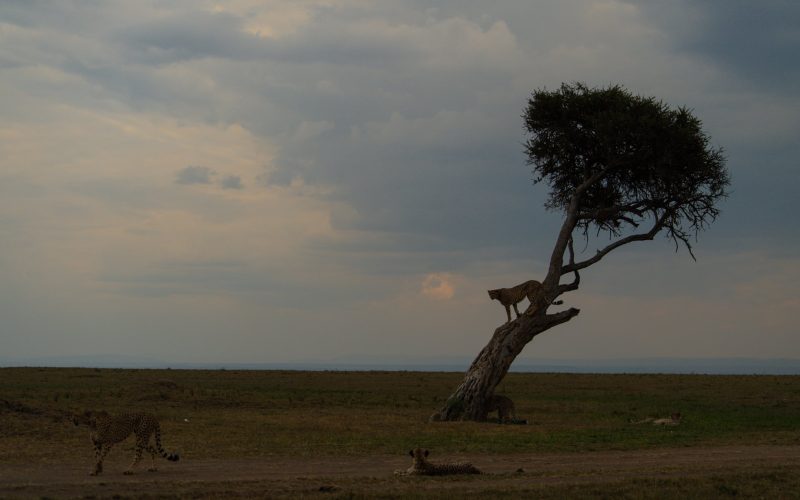
Cheetah, giraffe, zebra, topi and hippo are all routine. In the forest along the river you will find olive baboon, vervet and Sykes’ monkey. And more than 450 bird species, including some 57 raptors.

Breakfast where you land
The balloon comes down wherever the wind decides, and breakfast is laid out there — a table in the open, usually under an acacia, cooked in front of you. Coffee, eggs, fruit, something hot off a griddle, and the plain going about its morning around you.

It is the part guests describe afterwards more often than the flight.

When to go
Flights run year-round and the Mara does not have a bad season for this. Between July and October you have the migration underneath you, which is the single most extraordinary thing you can see from the air anywhere.
Outside those months you trade the herds for green ground, dramatic skies and a considerably quieter reserve. In the green season the plains are flowering and the light after rain is better than anything the dry months produce.

Practical notes
Flights launch at first light and last about an hour, weather permitting. Wind is the deciding factor and cancellations do happen — take the earliest morning of your stay rather than the last, so there is room to try again.
Baskets carry between eight and sixteen passengers depending on the operator. There is a minimum age, usually seven, and you need to be able to stand for an hour and manage a landing that may be brisk. Dress in layers: it is cold before dawn and warm by the time you are down.
It is booked separately from your stay, and we arrange it for guests as part of the day.

Half past four is early. Nobody has ever come back and said it was not worth it.