Due to the increased screen time, we have stopped gazing and dwelling deeper into the night's “low-fi” sky and instead are surrounded by grey ceilings. We are completely away from the cosmos.
Tourists often associate Kenya with the big wildebeest migration in the Mara and lions on the savannah; however, Kenya has a lot to offer that goes unnoticed in front of these. The natural marvel when the sun sets: a sky full of stars, galaxies, and astronomical events, hard to look for elsewhere around the globe!
The dark sky in the Maasai Mara is not an ordinary night sky; it is at the centre, attracting a celestial safari, equatorial stargazing,
There are no lies about this; the Maasai Mara offers something very rare, i.e., darkness. You might be thinking, how can darkness be rare? At the heart of the Maasai Mara, the sky is illuminated with clarity, as darkness is not emptiness, but it makes you feel present.
More than 80% of humanity lives under the light and polluted skies, and they are unable to see the Milky Way in its full brilliance. Now, in a world where the city skylines glow through the night, their artificial light obscures much of the cosmos, because of which true darkness has become a rarity.
It remains untouched by artificial illumination. Ilora Retreats becomes one of the most incredible locations for stargazing tours in Kenya, East Africa. The night sky here is huge, as what our ancestors used to see once upon a time – complex, and alive with celestial detail.
The fastest-growing travel trend of astrotourism in Africa is where it finds the most extraordinary stages.
Standing at the centre of the Earth: A Privilege
The visitors can witness and observe celestial objects from both hemispheres, and they get the best of both worlds. As the Masai Mara sits close to the equator that offers the travellers a unique astronomical advantage that fails for the observers far in northern or southern regions of the world.
Emerging & Experiencing the Stargaze
Have you ever imagined standing beneath the night sky of Africa and seeing constellations that are associated with both the Southern and Northern Hemispheres? It’s mesmerizing, right? There are a few destinations on Earth that offer such a balanced cosmic perspective.
This phenomenon is called the “Equatorial Stargazing,” which offers a unique chance to see a greater variety of stars, planets, and constellations all year long. Instead of merely seeing one half of the celestial sphere, visitors may see a vast astronomical panorama that varies somewhat with the seasons.
As a result, the night sky appears deeper, bigger, and immensely more engrossing.
Now, you might be thinking why Mara chose exclusively for stargazing. Hear me out. It has some of the best conditions for stargazing.
What Makes Mara Exceptional for Stargazing
Definitely, some weather conditions of Africa make it exceptional for astro tourism, and when it comes to the best spots in Kenya, the Masai Mara tops the list.
Darkness alone is not enough for a wonderful stargazing sight. The Masai Mara has the environmental factors that combine to make it the finest location for astrophotography and celestial observations.
Low-light-polluted areas
There are almost no urban light domes obstructing the view because there are no large cities in the area. Even faint celestial objects can be seen because artificial light, which usually obscures stars in developed areas, is mostly absent, establishing ideal circumstances for astronomical observations.
Visitors may see the Milky Way in all its splendor since there is no urban light pollution, which is becoming more and more uncommon in today’s world.
Clean Wilderness Air
Mara’s atmosphere is remarkably clearer than the urban environments that consist of dust, pollution, and industrial haze. The clean air acts as a transparent medium, allowing distant stars to appear bright and sharper.
Altitude and Atmospheric Thinness
Ilora sits at an elevation of over 5,000 feet. You know what this means? Improved viewing, creating greater clarity, of course, less or no atmospheric interference, making it easier for the observers to watch skies uninterrupted at higher altitudes. “Dark sky” environments are the term given by astronomers, which means the places where the universe is remarkably detailed.

The air is thinner and crisper here, as at this height, the traveller has already ascended above the densest, most humid layers of the Earth’s atmosphere.
A Celestial Safari: The Indigenous Perspective
Ilora is not merely a stargazing hubspot; it creates a deep immersion for humans to connect with the history in a more grounded way. The people of Masai used to be the guardians of the sky, before the inventions of the telescope, sextant, navigational tools, and cultural storytellers. The stars were not just illuminating bodies for them; they acted as calendars, a clock, and a sacred compass.
Mara has its daytime safari packed with lions, giraffes, deer, leopards, and elephants.
When it comes to nighttime, the Mara night sky presents its own unique and remarkable characters. One of them being Milky Way, the most dramatic sight.
Are you aware of some of the most recognizable equatorial night sky constellations? If you stay at Ilora Retreats, you are definitely going to witness them. We have got you covered.
The Pleiades
The Pleiades (also known as the Seven Sisters or Messier 45). It is a prominent, young cluster constellation.
Olikiramatian is the Masai name for The Pleiades; its appearance marks the beginning of the rains and renewal of the grass. It is situated about 440 light-years from Earth, contains over 1,000 stars, and is famous for the striking icy-blue hue of its brightest members.
Orion
During some seasons, Orion, one of the most well-known constellations in the world, dominates parts of the sky. Even novice stargazers may easily recognize it thanks to its brilliant stars and distinctive belt.
Scorpius
A beautiful constellation of the south is very prominent at various times of the year. Best known for its blazing red star Antares and its curved tail, one of the most distinctive patterns in the sky.
The Southern Cross
For centuries, travelers and navigators have used the Southern Cross as a guide. It is mostly visible from the Southern Hemisphere. Equatorial Africa is noted for its peculiar astronomical position viewed from the Mara.
The addition of planets, meteor showers, satellites, and seasonal celestial events means no two nights are the same.
Celestial observations have been an integral part of the Masais’ lives in terms of seasonal changes, livestock movements, weather changes, and agricultural cycles.
They have viewed the heavens as a vital part of life on Earth, not only existing as distant objects, just like many indigenous cultures around the world.
Astrotourism is not only astronomy, but it is also a perspective.
The connection between the sky and the landscape is still very important today. There is a deep sense of continuity between past and present as we stand beneath the same constellations that our ancestors have seen.
With an Ilora guide, you can have the experience of learning about the indigenous architecture of the sky, sitting by the embers of a fire.
How the camp is set up for it
A dark sky is not a feature that can be installed. It is what is left when a camp decides not to light itself, and it is lost the moment one floodlight goes up. Keeping it costs nothing and requires restraint every single night.
Three things make the difference here, and none of them are equipment.
We’ve designed our architecture to respect the heavens. We adhere to Dark Sky lighting principles, which means all ambient lighting is low-level, warm-toned, and directed purely downward. This isn’t just about energy; it’s about biology. By eliminating upward-shining lights, we preserve your natural night vision, the biological adaptation that allows your pupils to dilate fully and capture the faint photons of a galaxy millions of light-years away.
Characteristics of the Ilora Night:
The Sky Deck
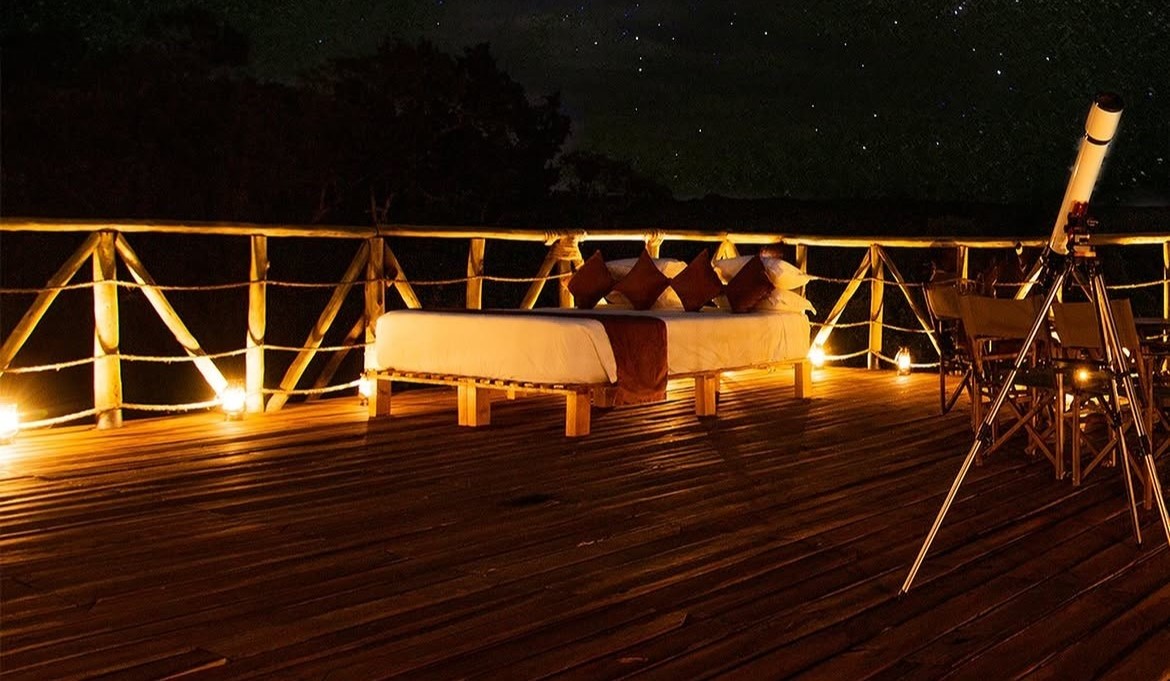
The camp has one raised deck given over to the sky, set away from the tents and clear of the canopy, with an unbroken horizon in every direction. There is no lighting on it at all — you walk out with a guide, your eyes adjust over about twenty minutes, and what arrives at the end of that adjustment is not the same sky you started with.
It is set up to be used lying down. Blankets, low seating, a telescope when the moon allows it, and enough room that a group can spread out without anyone speaking above a murmur. Guests use it for stargazing, for astrophotography, and for the sound bath we hold at dusk.
The Firelit Dialogue
We substitute the gentle, flickering light of the campfire for the glare of screens. This enables “unspoiled” stargazing, in which the eye is never forced to adapt to the harsh blue light of the contemporary environment.
Night-Time Stillness
The sound of the wind and the far-off cry of a nightjar are unmatched by any mechanical hum because we maintain 95% of our grounds as wild and forested.
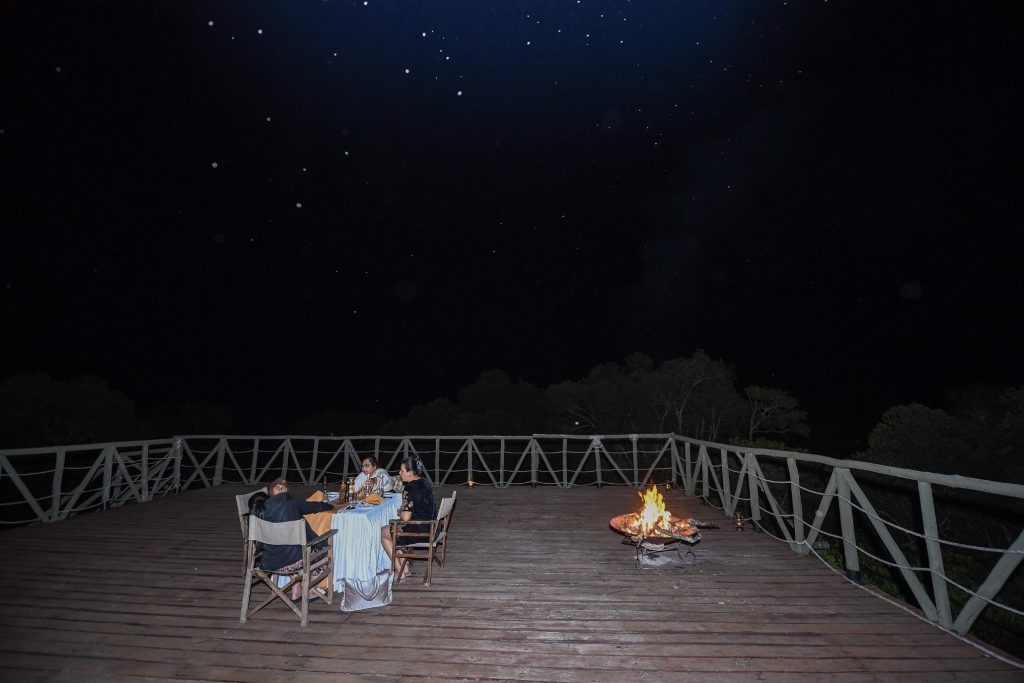
Astrophotography: Capturing the Infinite
The Mara’s night sky, due to lack of pollution, becomes the main attraction for the photographers because that “light pollution” becomes the “noise” which is virtually non-existent in the long exposure shots. For this patient and calm art, at Ilora, we provide the space and silence that is needed.
The clarity and visibility throughout is such that even the photographers who have started their careers, or are beginners, can capture images that might seem satellite ones, with the help of a little guidance, technique, and the right equipment, like a tripod or something.
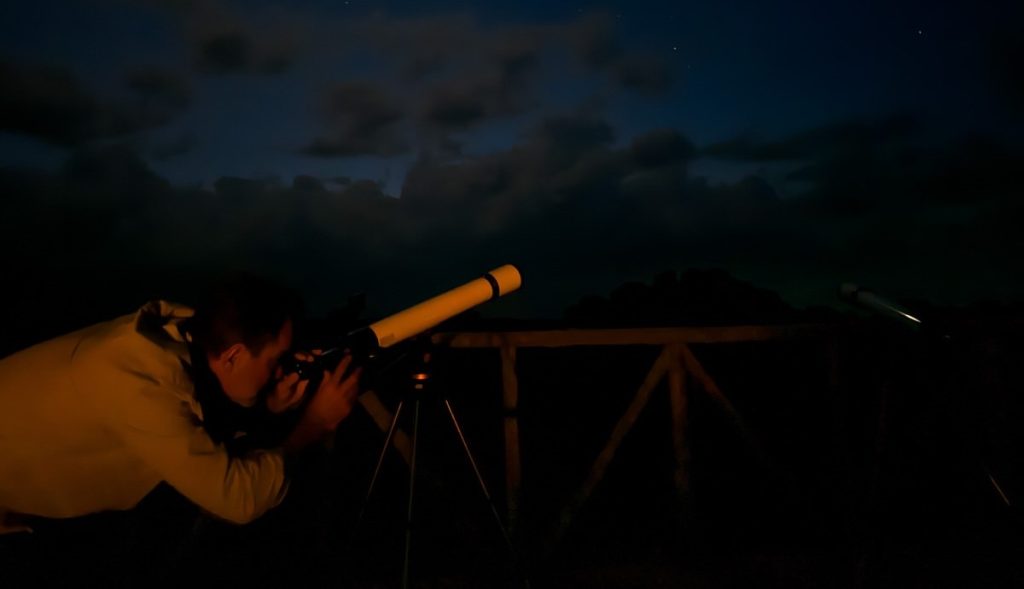
Looking up, to slow down
Our day-to-day life revolves around the mini universe that we have created for ourselves, right? The profound sky that has remained unchanged for several million years deserves a depth and essential amount of respect in observing it.
Stargazing definitely humbles a person’s ego and enriches the spirit.
It serves as a reminder that the night belongs to the infinite, but the day belongs to the hunter and the hunted.
When you look up at the Orion Nebula’s cosmic dust or Venus’ continuous, unrelenting brilliance piercing the twilight, you’re seeing light that came to Earth long before humans walked on these plains.
The world is much larger, much older, and much more beautiful than we generally assume when the planets cast modest shadows on the savannah floor, such as Jupiter with its steady, moderate light or Mars with its rust-red radiance.
We at Ilora do more than just provide lodging. We provide a space to awaken to the universe.