More than 450 species of bird live in or pass through the Masai Mara, including some 57 raptors. That is a higher count than most people's entire life list, in an area smaller than Norfolk.
The reason is habitat. Open grassland, acacia woodland, riverine forest along the Mara and Talek, wetland, rocky escarpment and seasonal marsh all sit within a few kilometres of each other, and each holds a different set of birds. Residents are here year-round; between November and March they are joined by migrants from Europe and Asia, which is when the birding is at its best and the camps are at their quietest.
Below are the ones you are most likely to notice, and a few worth looking for.
African paradise flycatcher
Small, restless, and impossible to ignore once you know it. Chestnut back and tail, blue-black head, and in the male a pair of central tail streamers up to twenty centimetres long — nearly twice his body length — trailing behind him through the riverine forest.

Both sexes build the nest, a neat cup bound with spider web. Listen for them before you see them; the call carries.
Turacos
Two species here, both in forest and along the river.

Schalow’s turaco is green over the head and breast, blue behind, with a long forward-pointing green crest. Ross’s turaco is deep violet-blue with a short crimson crest and a yellow bill.
Both share the trick worth waiting for: the wing feathers carry turacin, a genuine red pigment found in no other bird family, and when they open their wings to glide, the crimson is startling.
Little bee-eater
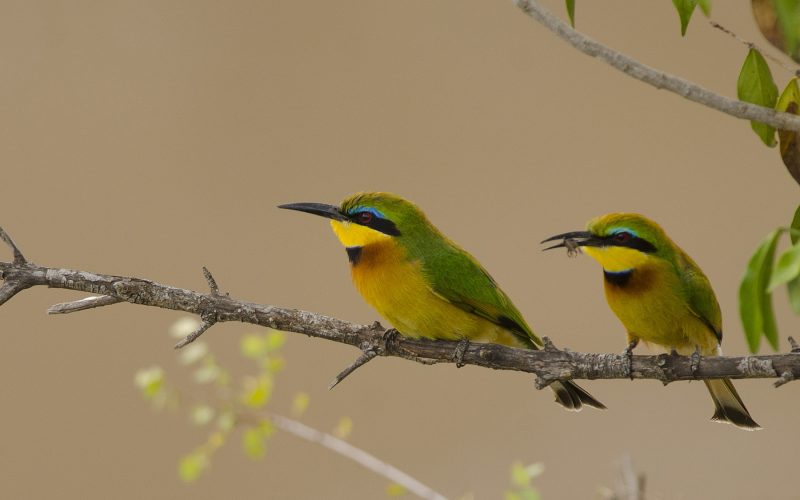
Fifteen centimetres of green back, yellow throat and a black gorget, usually in pairs on a low perch near water.
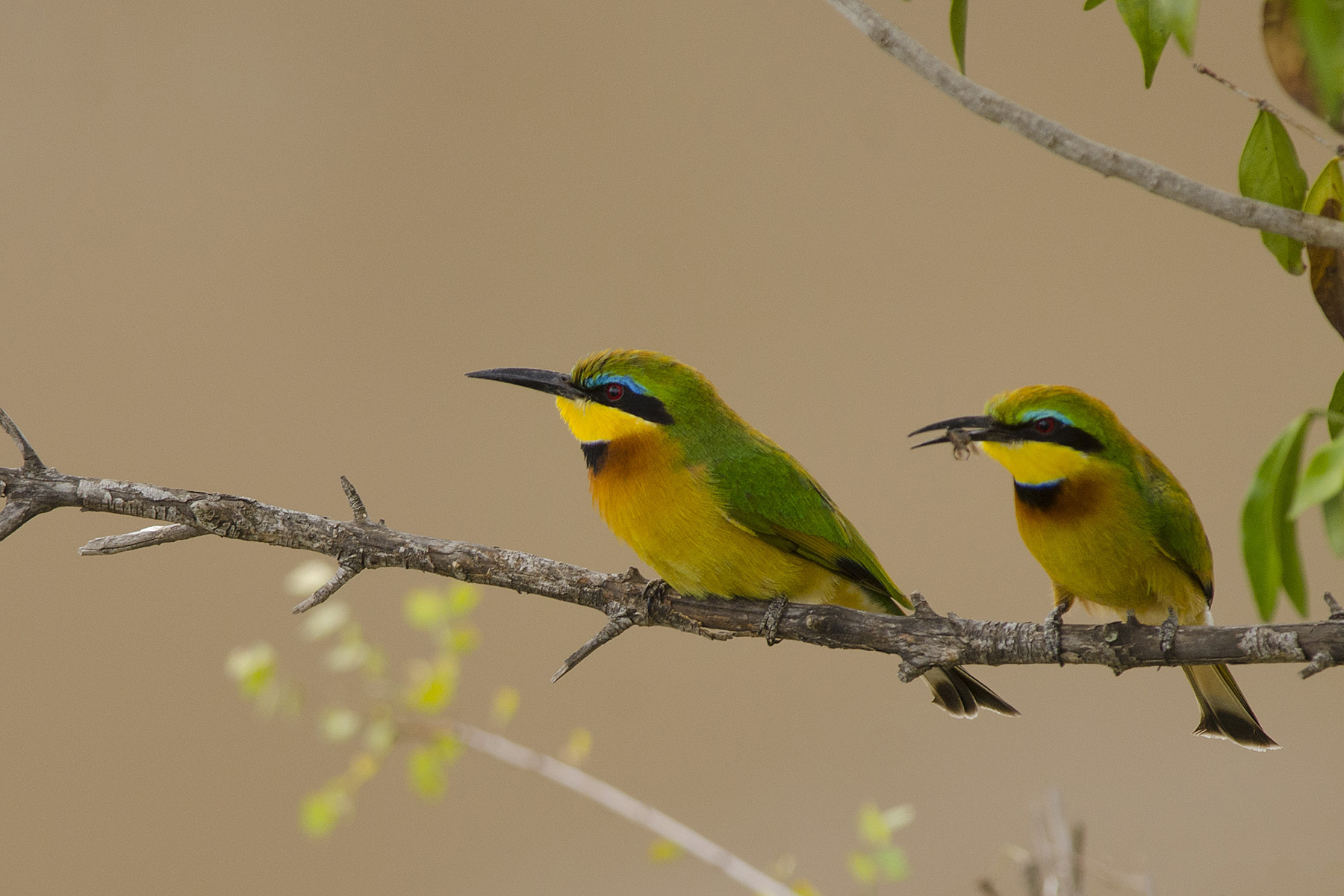
They hunt bees, wasps and hornets on the wing, then return to the same perch and beat the insect repeatedly against it — a manoeuvre that both kills it and discharges the sting before it is swallowed. Watch one for five minutes and you will see the whole sequence several times.
Starlings
The superb starling is the bird that will join you at breakfast: iridescent blue back and throat, chestnut belly, black head, and a clean white band between the two.

Rüppell’s starling is larger and longer-tailed, glossy blue-black throughout, with a tail that turns purple in the right light.
Both are common, social, and entirely unbothered by people, which makes them a good place to start learning the difference between iridescence and pigment.
Lilac-breasted roller
The one on every postcard, and it deserves it: lilac throat, greenish crown, turquoise belly, and a rufous back, usually perched on an exposed branch scanning for insects and lizards.

The name comes from the courtship display — the male climbs, then drops in a rolling, side-to-side dive while calling. If you see one climbing steeply for no reason, keep watching.
Kori bustard
The heaviest flying bird in the world, at up to twenty kilograms, and about 1.3 metres tall. Grey-brown above, white below, with a black crest.
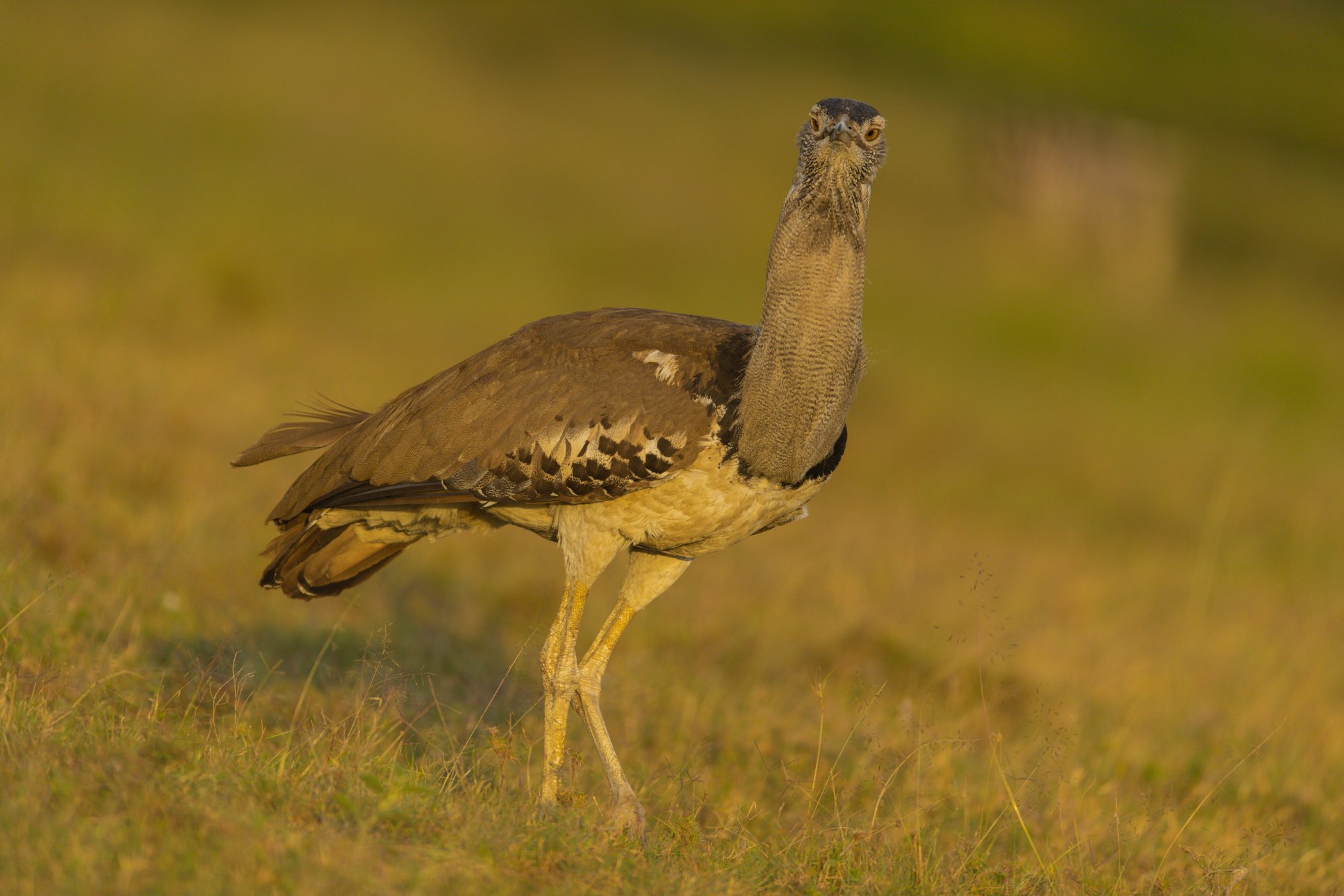
It walks the grassland slowly, taking insects, reptiles and seeds. The display is worth seeing: the male inflates his throat to four times its normal size, raises his tail over his back and produces a low booming call that carries several hundred metres.
Grey crowned crane
Kenya’s most elegant bird and, on the IUCN list, an endangered one. Slate grey body, white wings, red throat wattle, and a spray of stiff golden feathers on the crown.

They pair for life and dance — bowing, jumping, throwing grass — not only in courtship but apparently for its own sake. Look near marsh and standing water.
Yellow-throated sandgrouse
Bulky, short-legged, olive-brown, easily walked past. The male has a black collar; the female is mottled.
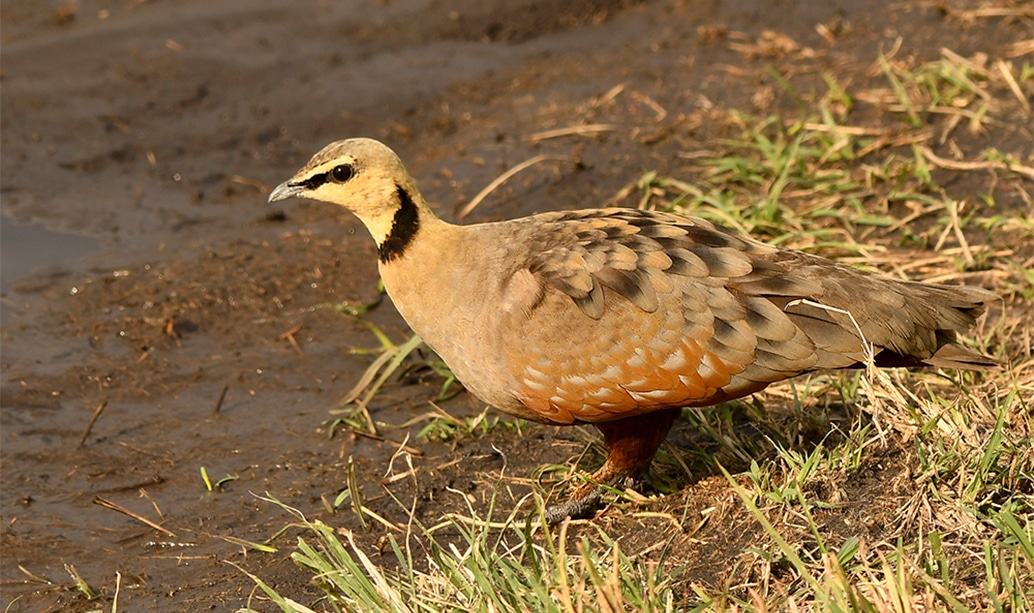
What makes sandgrouse extraordinary is invisible unless you are there at the right hour: the male’s belly feathers are structured to absorb water, and he flies to a waterhole, soaks himself, and carries it back to chicks that may be twenty kilometres away.
The raptors
Fifty-seven species, and the reason serious birders come. Martial eagle and bateleur overhead, augur buzzard along the escarpment, and six species of vulture on any carcass more than an hour old — Rüppell’s, white-backed, lappet-faced, hooded, white-headed and Egyptian.
Vulture populations across East Africa have collapsed by more than eighty percent in thirty years, mostly through poisoning. What looks like an ordinary sight at a kill is, in fact, increasingly rare.
Secretarybirds stride the short grass hunting snakes on foot. Ostrich are here too — flightless, and the largest bird alive.
Birding at Ilora
Our guides bird as seriously as they track, and the camp sits in riverine forest, which means the list starts before you leave. Dawn on the deck with coffee and binoculars will produce twenty species without moving.
Ask for a dedicated birding morning and you will go slowly, on foot where the ground allows, and stop for things a game drive would pass. November to March, when the migrants are in, is the season to do it.