Kenya's best-known reserve earns the reputation. It has been filmed more than almost any wilderness on earth — Big Cat Diary and Big Cat Tales both worked this ground, following individual lions and leopards across years — and it draws researchers as consistently as it draws visitors.
Here is what actually justifies the trip.
The density
The Mara holds around 95 species of mammal and more than 450 of bird in 1,510 square kilometres. The concentration of large predators is among the highest anywhere in Africa: between 800 and 900 lion live in the reserve and its bordering conservancies.
Lion, leopard, elephant and buffalo are close to routine. Black rhino live here too, mostly in the west, but there are fewer than fifty and a sighting is a bonus rather than an expectation — anyone who tells you otherwise is guessing on your behalf.
Cheetah favour the short grass. Hyena clans are everywhere and are far more interesting than their reputation. Hippo and very large Nile crocodile hold the Mara and Talek rivers.
Density is the thing that separates this from most reserves, and it changes what a day feels like. In much of Africa a game drive is a search. Here it is closer to a sequence: you are rarely more than twenty minutes from the next thing worth stopping for, which means a guide can afford to sit with one animal for an hour rather than pushing on to fill a list.
The migration
Around 1.5 million wildebeest move with several hundred thousand zebra and gazelle in a continuous loop between the Serengeti and the Mara, following rain and grass.
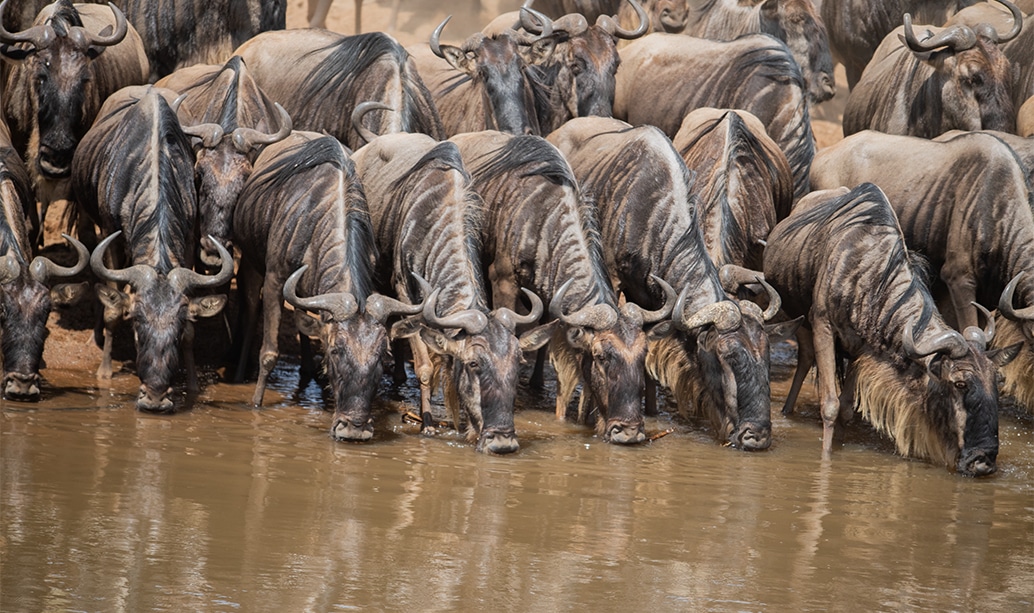
They reach Kenya around July and stay into October, and the Mara River crossings are what people come for: steep banks, strong current, and crocodile that have waited eleven months for this. A herd will mass at a crossing for three hours, refuse, and walk away. Nobody can tell you which day one will go.
Two things are worth saying plainly about it. The first is that the crossing is not a scheduled event and cannot be sold as one. Guides read the build-up — the herd committing to a bank, the front animals stopping being pushed back — but the trigger is opaque and often nothing happens at all. Come for four nights in September and you will very likely see one. Come for two and you are gambling.
The second is that there is a second migration, and almost nobody mentions it. A separate wildebeest population breeds on the Loita Plains north-east of the reserve and moves down into the Mara from around May or June — weeks ahead of the Serengeti herds — returning when the short rains break in November. If you want herds without the July crowd, that is the window.
The country
Open grassland to the horizon, broken by umbrella thorn and croton thicket, cut by the Mara and Talek rivers, and closed on the west by the Oloololo escarpment. Riverine forest along the water, rocky outcrops, rolling hills.
It is unusually good country for seeing things. In thicker reserves you photograph through vegetation; here you watch a hunt develop from three hundred metres.
That openness is also what makes the Mara the best place in Africa to learn how an ecosystem fits together, rather than simply to tick species off. You can watch grazing succession happen in front of you — zebra taking the tall coarse growth, wildebeest following into what they have opened, Thomson’s gazelle last onto the short regrowth. You can see why a cheetah is where it is, and why a leopard is somewhere else entirely.
What you can do
Game drives are the backbone, morning and late afternoon, when the animals move and the light is worth having.

Balloon flights lift off before dawn and drift low across the plains — the one way to see the shape of the ecosystem rather than its inhabitants. Photography vehicles run to no fixed schedule, so you can sit with one leopard for two hours. Walking safaris and night drives are permitted in the private conservancies bordering the reserve, though not inside the reserve itself.
The quieter things are underrated. A bush breakfast under a tree after a long morning. Stargazing from a deck with no light within thirty kilometres, on the equator, where you can see both the Southern Cross and the northern constellations from the same spot. A sound bath at dusk with the plain as the other half of the composition. None of these are why people book, and they are frequently what people talk about afterwards.
The Maasai
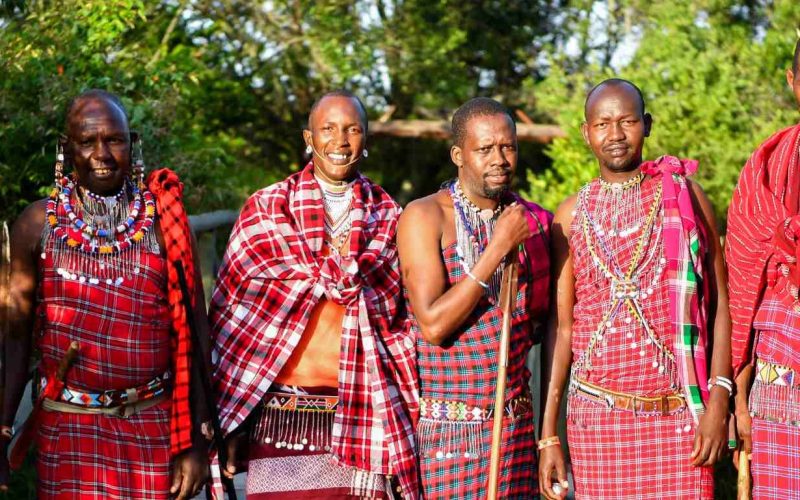
This is Maasai land, and has been for around four centuries. They still live on and around the reserve, and the conservancies exist because Maasai families chose to lease their land and keep it open for wildlife rather than fence and farm it. Much of the ecosystem survives on that decision.
The arrangement is worth understanding. Individual landowners lease their parcels into one continuous block and receive a payment per acre every month, whether or not a guest arrives. Fences come down, grazing is planned across the whole block, and the number of camps and vehicles is capped by agreement. That is the mechanism by which your booking becomes a reason for a fence to stay down.
A village visit, done through a camp that works with a named community on agreed terms, is worth an afternoon. Done badly it is a photo stop with a fixed fee — so ask how it is arranged before you agree to go.
When to come
There is no bad month, only different trades.
July to October is the migration and the short gold grass, and it is also the crowd and the highest rates, booked a year ahead. November and December bring storm light, migrant birds arriving from Europe and Asia, and camps at half occupancy. January to March is hot, clear and settled, with resident antelope calving and cats with young cubs. April and May are green, wet, difficult underfoot and almost empty — the most private the Mara ever gets, if you do not mind mud.
The resident game does not leave in any of those months. What changes is how easily you see it, how many vehicles are watching with you, and what you pay.
How long
Three nights is the minimum that makes sense. You arrive on day one and the safari genuinely starts on day two. Four or five nights in a single camp is where most people would put the money if they could go back and do it again.
The common mistake is spreading a week across three camps in order to see more. Every move costs a morning, and the thing that makes a safari memorable is not variety of address — it is having enough time in one place to stop chasing.
What makes the difference
Not whether you come, but where you sleep.
A camp inside the reserve is among animals within minutes of leaving, at first light, when everything is moving. A camp beyond the gates spends the first hour of every morning driving in, and arrives as the light goes flat.
Over four nights that is four of the best hours of your trip, and it is the one decision you cannot fix once you are here.
Ilora sits on thirty acres of central Olkiombo, inside the reserve, with fourteen suites and no more than thirty-five guests. Under five percent of the ground carries any structure; the rest is left as riverine forest and grass so that game moves through rather than around. That is the whole proposition, and it is mostly about where you wake up.
Unrushed. By nature.